
Douglas Scheduled Versus Actual Release
A projected date is an estimate or sentence-based milestone. Actual release is the custody event recorded after legal authority to hold the person ends or moves. Douglas County records can include bond, time served, a court order, dismissal, completion of a probation-violation sanction, or transfer. Those county events do not use the same calculation as a state-prison sentence.
Pretrial detainees have no set sentence-completion date because the criminal case has not reached final sentencing. A bond order may create a possible path out, but bond approval and physical departure are separate. Processing, another warrant, a detainer, or transfer can keep the person in custody. The sheriff’s release entry provides the actual date and time.
Find Douglas County Release Dates
Start with the last known custodian. This prevents a county jail search from being used for a state prisoner and keeps a tentative parole date from being read as a completed release.
- Search the Douglas County Jail portal to see whether a local detainee remains portal-visible.
- Review the Douglas County court docket for bond, sentencing, amended sentence, probation, dismissal, or revocation entries.
- Ask Sheriff’s Records Division for custody dates, the booking-and-release record, release reason, or Proof of Incarceration.
- For a state offender, search GDC by GDC ID or name and review sentence, status, MRD, and release fields.
- Check the Parole Board’s TPM lookup if parole consideration applies.
- Confirm conflicting state dates in writing with GDC Inmate Records and Information.
The broader Douglas County release-record workflow helps when the person’s last system is unknown. BOP and ICE records must be used for federal and immigration custody.
Douglas County Jail Date Sources
The official jail search begins at jaildcga.com and redirects to the sheriff’s Zuercher portal. It is chiefly a live custody tool. A person’s absence may mean release, transfer, spelling variation, delay, or a different custody system. The reviewed sources do not publish a local good-time calculator or a guaranteed projected-date field.
For a sentenced county-jail term, use the sentence order in the Douglas County court search and ask Records Division how jail credit or time served was applied. Search names as LAST NAME, FIRST NAME. Court data explains legal authority; the jail record confirms the custody event. Records Division can be reached at records@sheriff.douglas.ga.us or 770-942-2121.
- Jail credit
- Time credited toward a sentence for qualifying prior custody.
- Time served
- A sentence or sanction completed through time already spent in custody.
- Detainer
- A request from another agency that can change the release destination.
- Remand
- A court order sending a person back into custody.
Douglas GDC Projected Release Search
The GDC offender query is the state-prison source. Search by GDC ID when possible, or use name fields and compare identifiers. Review status, facility, offense and sentence data, release fields, and MRD. A Douglas County conviction can lead to this record after sentence and transfer, but a local bond release may never appear in GDC.
The official offender query is shown below as the state source for sentence and release-related fields.
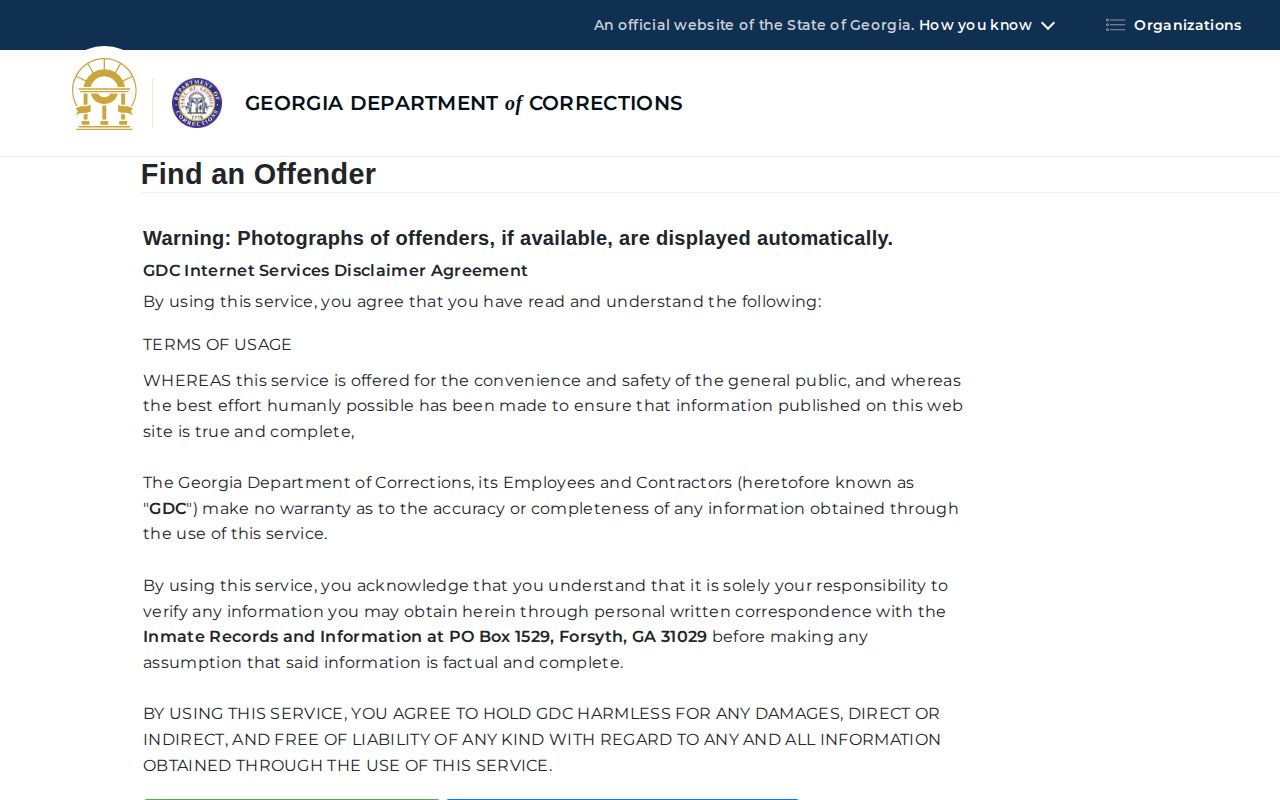
GDC warns that online information may be incomplete and advises written verification through Inmate Records and Information, PO Box 1529, Forsyth, GA 31029. This matters when an amended sentence, missing jail credit, or data-entry delay appears to create a conflict.
Douglas MRD, TPM, and PIC
This state distinction is Douglas County’s key release-date computation issue. GDC defines Maximum Release Date, or MRD, as the date the judge’s sentence is fully served. The Georgia State Board of Pardons and Paroles defines Tentative Parole Month, or TPM, as the month for final review and possible setting of a parole release date. A TPM is not a final decision and may be postponed or canceled.
| Term | Meaning | What it does not prove |
|---|---|---|
| MRD or max-out | Date the full judicial sentence is served under GDC calculation. | It is not an early parole date. |
| TPM | Month for Parole Board final review and possible release-date setting. | It is not a grant or actual release. |
| PIC | Performance Incentive Credit for eligible state offenders. | It does not apply to every sentence. |
| Actual release | Completed custody event recorded by the holding agency. | It does not prove the court case disappeared. |
The Parole Board TPM explainer should be read before using its lookup. Conduct and program completion can affect the Board’s final review.
Douglas Performance Credit Rules
GDC’s Performance Incentive Credit program allows eligible offenders to accumulate up to 12 points, with a potential reduction of one to 12 months from TPM or MRD. The program excludes several groups, including death sentences, terms of two years or less, life sentences, and non-parole-eligible or mandatory-minimum categories.
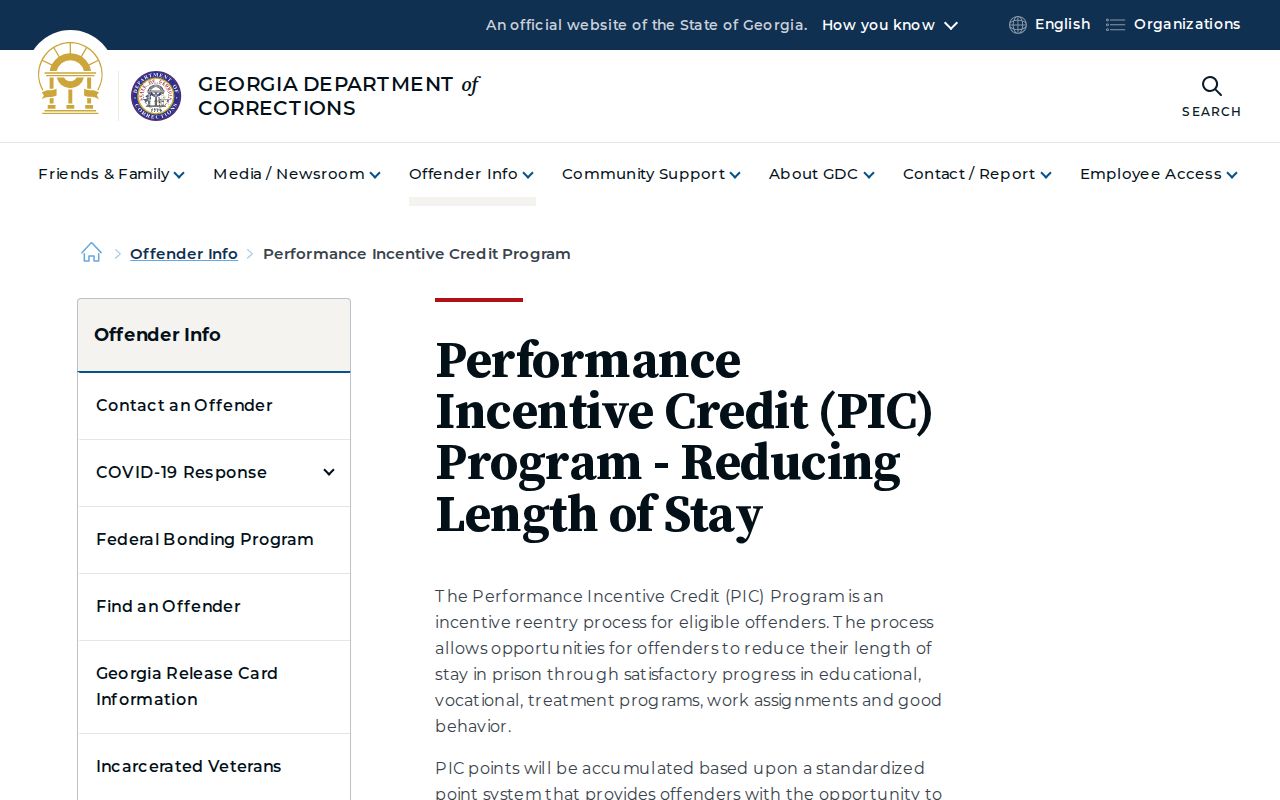
O.C.G.A. § 42-5-101 authorizes work incentive credits tied to institutional attainments, work assignments, and satisfactory behavior. Georgia rules also address work incentive credits and their report to the Parole Board. Credits are one part of the official calculation, not a number a searcher should subtract independently.
Why Douglas Release Dates Change
A date may move because the legal record, agency calculation, conduct record, or release destination changed. The source of the change points to the office that can explain it.
| Factor | Possible effect | Best source |
|---|---|---|
| Amended court sentence | Changes the term or sentence structure. | Douglas County court docket |
| Jail credit correction | Moves the sentence start or completion calculation. | Court and holding agency |
| PIC award or adjustment | May reduce eligible TPM or MRD. | GDC |
| Misconduct or unmet program | May postpone or cancel tentative parole timing. | Parole Board and GDC |
| Parole grant or denial | Sets, changes, or removes an earlier pathway. | Parole Board |
| Detainer or transfer | Changes where the person goes at county or state release. | Releasing and receiving agencies |
| Data delay | Leaves an online field behind the official file. | Agency records office |
A transfer from Douglas County Jail to GDC changes which system owns the answer. Likewise, a federal or ICE transfer makes a county projected date incomplete because the receiving agency may continue custody.
Douglas Parole Eligibility Limits
Georgia should not be reduced to a blanket “85 percent rule.” The Parole Board says most parole-eligible inmates become statutorily eligible after one-third of the prison sentence, but eligibility is not release. Few receive parole at the first eligibility point. Certain serious violent felony sentences with qualifying crime dates are not eligible for parole consideration under the state framework.
O.C.G.A. § 17-10-6.1 addresses serious violent felonies and mandatory sentencing. Offense, sentence date, sentence type, and parole eligibility must be reviewed together. The Board may set a TPM, deny parole, or later change a tentative action. A life-sentence case follows a different grant-or-deny process. Only the responsible state agencies can apply these rules to one person’s sentence.
Confirm Douglas Actual Release
A scheduled date should be checked again close to the event. Georgia VINE can send an automated custody-change alert for a participating source. The Douglas VINELink inmate search explains registration and the four-digit phone PIN. An alert still needs official confirmation.
For a county release, ask the sheriff for release date, time, reason, and receiving agency if transferred. For state prison, compare the GDC detail with Parole Board information and written GDC verification. Court records explain the legal cause. This layered check separates a date on a screen from the actual end or transfer of custody.
Request language should be precise. For Douglas County Jail, provide the full name, date of birth if known, booking number, arrest date, and the date range in question. Ask whether the entry was a community release or transfer. A Proof of Incarceration can confirm the custody span even when it does not list every reason. For GDC, include the GDC ID and identify the date field that needs clarification.
Release planning must account for the destination as well as the day. A detainer may send the person to another county, GDC, federal authorities, or ICE. Parole release adds a supervising office and conditions. Probation can follow a county sentence through the court. None of those outcomes is captured by simply subtracting days from a sentence. The official record must show which agency has authority at the end of each stage.
Save the date when each portal was checked. That timestamp helps reconcile later changes with the final agency record.